
Ranger 7 facts for kids
 |
|
| Mission type | Lunar impactor |
|---|---|
| Operator | NASA / JPL |
| Mission duration | 2 days, 20 hours and 35 minutes |
| Spacecraft properties | |
| Manufacturer | Jet Propulsion Laboratory |
| Launch mass | 365.6 kg (806 lb) |
| Dimensions | 1.52 m × 2.51 m (5.0 ft × 8.2 ft) |
| Power | 200 W |
| Start of mission | |
| Launch date | July 28, 1964, 16:50:07 UTC |
| Rocket | Atlas LV-3 Agena-B (250D / AA9) |
| Launch site | Cape Canaveral, LC-12 |
| Lunar impactor | |
| Impact date | July 31, 1964, 13:25:48.82 UTC |
| Impact site | 10°38′02″S 20°40′38″W / 10.6340°S 20.6771°W (Between Mare Nubium and Oceanus Procellarum) |
|
Ranger program
|
|
Ranger 7 was a special space probe sent by NASA to the Moon. It was the first time a NASA spacecraft successfully sent back close-up pictures of the lunar surface. This mission was a huge success for the Ranger program, which aimed to explore the Moon.
Ranger 7 launched on July 28, 1964. Its main job was to fly towards the Moon and take many high-quality photos. It sent these pictures back to Earth during the last few minutes of its flight, right up until it crashed into the Moon.
The spacecraft had six special television cameras. Two were wide-angle cameras, and four were narrow-angle cameras. These cameras were set up in two separate systems. Each system had its own power, timers, and transmitters. This design made sure that if one system had a problem, the other could still work. This helped guarantee that scientists would get good pictures.
Ranger 7 sent back over 4,300 amazing photos. These pictures were taken during the final 17 minutes of its journey. After flying for about 68.6 hours, the spacecraft impacted the Moon. It landed in an area between two large lunar plains, Mare Nubium and Oceanus Procellarum. This landing spot was later named Mare Cognitum. Ranger 7 hit the Moon at a speed of about 2.62 kilometers per second (1.63 mi/s). The mission worked even better than scientists had hoped! Ranger 7 did not carry any other experiments besides its cameras.
Contents
Ranger 7: A Moon Mission Success!
Why Ranger 7 Was So Important
Before Ranger 7, NASA had faced challenges with its Moon missions. The previous mission, Ranger 6, had a problem with its cameras. Even though most of Ranger 6 worked well, the cameras failed to send pictures. This made some people wonder if the Jet Propulsion Laboratory (JPL), which built the spacecraft, could succeed.
Scientists at JPL quickly investigated why Ranger 6's cameras failed. They discovered that an electrical problem caused the cameras to turn on too early. This drained their power before they could reach the Moon. Finding the exact cause was tricky, but they worked hard to understand it.
How Ranger 7 Was Built

Ranger 7 was part of a group of spacecraft called the Block 3 Rangers. These included Ranger 6, 7, 8, and 9. The spacecraft had a base shaped like a hexagon, about 1.5 meters (4 ft 11 in) wide. This base held the engines and power systems. On top was a cone-shaped tower where the TV cameras were placed.
Two large solar panels extended from the sides of the base. Each panel was about 739 millimeters (29.1 in) wide and 1,537 millimeters (60.5 in) long. When fully open, they stretched 4.6 meters (15 ft) across. A special antenna, shaped like a dish, was also attached. This antenna could point towards Earth to send signals. A smaller, round antenna sat on top of the camera tower. The entire spacecraft was about 3.6 meters (12 ft) tall.
Powering the Spacecraft
Ranger 7 used a special engine for small course corrections during its flight. This engine used a fuel called hydrazine. Small jets of nitrogen gas helped control the spacecraft's direction. These jets worked with sensors that detected the Sun and Earth. This kept Ranger 7 pointed correctly in space.
The two solar panels were covered with 9,792 solar cells. These cells collected sunlight to create electricity. They produced about 200 watts of power. The spacecraft also had several batteries. These batteries stored power for the cameras and other systems. They could keep the spacecraft running for many hours.
Talking to Earth
Ranger 7 communicated with Earth using its antennas. It had a low-gain antenna for general signals and a high-gain dish antenna for sending detailed information. The spacecraft had three transmitters. Two were for sending TV pictures, and one was for other data. These systems converted the camera signals into radio waves. This allowed the amazing pictures to be sent across space to Earth.
The Journey to the Moon

Fixing Past Problems
To prevent another camera failure, engineers made important changes for Ranger 7. They developed new ways to test the spacecraft's power systems. These tests were done away from the launch pad. This avoided any risk of accidentally starting the engine while the rocket was full of fuel.
JPL originally wanted Ranger 7 to hit the same area as Ranger 6. This would allow them to photograph the impact crater. However, the lighting conditions on the Moon would not be right in July. So, they chose a different, less-known area. This new target was about 11 degrees south of the Moon's equator, near the Sea of Storms.
Launch Day Excitement
On July 27, 1964, the first attempt to launch Ranger 7 was delayed. A battery problem in the rocket caused the hold. But the next day, everything went perfectly. Ranger 7 lifted off from Cape Canaveral at 12:50 PM EST. The sky was clear, and cameras watched the rocket as it climbed. This time, there were no unexpected problems. About 30 minutes after launch, the rocket's second stage fired. This pushed Ranger 7 onto its path toward the Moon.
First Pictures of the Moon
Ranger 7's flight path was very accurate. Still, a small adjustment was made on July 29. This ensured the spacecraft would hit the Sea of Storms area. Scientists also changed how they warmed up the cameras. They made the warm-up shorter and earlier than on Ranger 6. This was to avoid any risks.
At 6:09 AM PDT, the first video images from Ranger 7 arrived on Earth. As Ranger 7 got closer to the Moon, its cameras worked perfectly. Pictures of the Moon's cratered surface streamed back to JPL headquarters. Finally, at 6:25 AM PDT, Ranger 7 impacted the Moon. All signals from the probe stopped. The control room erupted in cheers!
What Ranger 7 Taught Us
Ranger 7 delivered the first close-up images of the Moon's surface. This was a huge achievement for the United States in the Space Race. The pictures showed that the Moon was very rugged and rocky. It had debris scattered everywhere.
Scientists wondered if the Moon's surface was solid enough for humans to land on. Geologist Gerard Kuiper studied the images. He thought that some parts of the Moon looked smooth enough for a spacecraft. However, the exact hardness of the surface could not be known for sure until a soft landing happened. Still, Ranger 7's pictures suggested the Moon was firm enough.
Ranger 7 reached the Moon on July 31. It began sending pictures 18 minutes before impact. The first image was taken from an altitude of 2,110 kilometers (1,310 mi). Over the final 17 minutes of its flight, Ranger 7 sent 4,308 excellent photographs. The very last picture, taken just before impact, showed details as small as 0.5 meters (1.6 ft).
The mission was a complete success. It changed NASA's luck after many earlier lunar probe failures. Ranger 7 also started a fun tradition at NASA. When the mission succeeded, someone in the control room was eating peanuts. Since 1964, mission control rooms often open a container of peanuts for good luck during launches and important events!
Images for kids
- Ranger 7 descent images
-
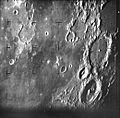
First image, about 17 minutes before impact. Features: The large crater at center right is Alphonsus.
-
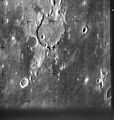
Altitude: 830 miles (1,340 km). Features: Image of Guericke crater, taken 8.5 minutes before impact.
-
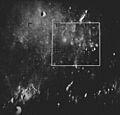
Altitude: 235 miles (378 km). Features: Note increase in detail of Bonpland H and its twin crater (to left of Bonpland H).
-
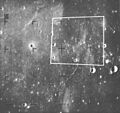
Altitude: 85 miles (137 km). Features: Cluster of secondary craters in part of a ray of the Crater Tycho becomes distinct.
-
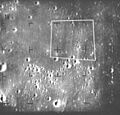
Altitude: 34 miles (55 km). Features: Greater resolution of craters in outlying ray of Tycho.
-
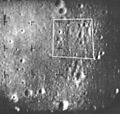
Altitude: 11 miles (18 km). Features: Crater near upper left of area outlined in white.
-
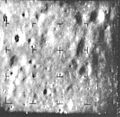
Altitude: 3.6 miles (5.8 km). Features: Angular rock mass in crater at upper left. Preliminary study indicates the mass to be several separate chunks.
-
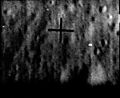
Photo taken by Ranger 7 at 3,000 foot (910 m) altitude shows area 100 feet (30 m) in each side.
-
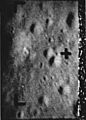
Last picture by Ranger 7, taken about 1,600 feet (490 m) above the moon, reveals features as small as 15 inches (0.38 m) across. Receiver noise pattern at right results from spacecraft crash on the moon while transmitting.


See also
- Ranger program
- Timeline of Solar System exploration
- List of artificial objects on the Moon
- List of missions to the Moon
